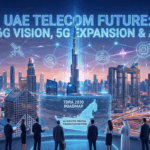


The United Arab Emirates is widely recognized as one of the most advanced, connected, and futuristic nations in the world. But behind its remarkable success lies a foundation that was laid quietly and strategically from the earliest years of nationhood—telecommunications. As the UAE celebrates National Day, it is worth looking back at how the telecom sector has played a crucial role in the nation’s development, unity, and global identity.
Telecommunications is not just about phone calls or internet connections. In the UAE’s context, it has been a nation-builder, a growth engine, and a driver of transformation. From connecting remote deserts to enabling futuristic smart cities, telecom has been at the heart of the UAE’s journey since 1971.
1. Connecting a New Nation: The Foundations of UAE Telecom
When the UAE was formed, one of the leadership’s first priorities was to create a unified communications network. At that time, the region was geographically spread out and developing infrastructure was challenging. The early telecom initiatives ensured seamless communication between the seven emirates, government departments, security forces, financial institutions, and essential services.
Establishing these networks was not merely about convenience—it was about creating national unity. Reliable communication strengthened cooperation between emirates, helped stabilize governance, and accelerated decision-making during the nation’s early years. Even before skyscrapers and world-class highways, telecom networks became one of the UAE’s first modern infrastructures.
2. Fueling Economic Growth and Global Competitiveness
As the UAE began shaping its economy, telecommunications played a pivotal role. Industries such as oil & gas, aviation, banking, logistics, and tourism relied heavily on robust communication channels. Ports, free zones, airports, and trade hubs all required reliable telecom systems to operate efficiently.
Telecommunications also strengthened the UAE’s global competitiveness. Investors and multinational companies were drawn to a country that had modern communication systems, offering stability and digital readiness much earlier than many other nations in the region. The UAE’s commitment to technology meant businesses could scale, stay connected internationally, and operate with global standards.
This early investment became the backbone for Dubai’s rise as a financial hub and Abu Dhabi’s growth as an energy powerhouse. Without telecom infrastructure, none of these sectors could have expanded at the speed or scale the UAE achieved.
3. Transforming into a Digital Nation
From the 2000s onwards, the UAE shifted from basic connectivity to digital transformation. Fiber-optic networks expanded rapidly, making the UAE one of the highest fiber-to-the-home penetration countries in the world. Simultaneously, the country embraced 3G, 4G, and later became one of the earliest adopters of 5G technology, transforming the region’s digital landscape.
Today, telecom powers nearly every aspect of UAE life:
- Smart cities such as Dubai and Abu Dhabi
- E-government platforms providing paperless services
- AI-powered public safety systems
- Telemedicine and digital health
- Cloud-based businesses and startups
- Smart transportation and autonomous mobility
This shift has created an ecosystem where residents enjoy high-speed connectivity, businesses operate globally with ease, and government services function with exceptional efficiency.
4. Empowering Communities and Improving Quality of Life
Telecom’s impact is not limited to industries and government. It has played a major role in transforming everyday life in the UAE.
From enabling video calls for families to providing online education for students, telecom has made global communication accessible to everyone. The rise of digital payments, online shopping, social media, and content creators all stems from the strong telecom backbone.
During challenging times—such as global lockdowns—telecom kept communities connected, businesses running, and services uninterrupted. It demonstrated how deeply technology is woven into the UAE’s social fabric.
5. Strengthening Visionary Leadership and Innovation
The UAE’s leadership believes in staying ahead of the future, not waiting for it. This vision has transformed telecom from a basic service into a strategic pillar of national progress.
Government initiatives like smart governance, AI strategy, paperless cities, and digital transformation all depend on advanced telecom networks. This leadership-driven approach ensures the UAE remains at the forefront of global innovation.
Telecom companies and technology manufacturers also play a vital part in introducing modern solutions, supporting ISPs, enabling fiber deployment, and expanding wireless coverage across the country.
Conclusion: Telecom Didn’t Just Connect the UAE—It Helped Build It
As the UAE celebrates National Day, the contribution of telecommunications stands tall as one of the key elements that shaped the country’s success. From uniting the emirates during the early days to powering world-leading smart cities today, telecom has been a pillar of national development.
🌐 Website: www.netlinkict.ae
📧 Email: [email protected]
📞 Contact: +971 5071 21072 | +971 5636 54908
Let’s keep moving forward — toward a smarter, connected tomorrow! 🚀